Who Is Your AI Agent Acting For? RFC 8693 On-Behalf-Of Delegation
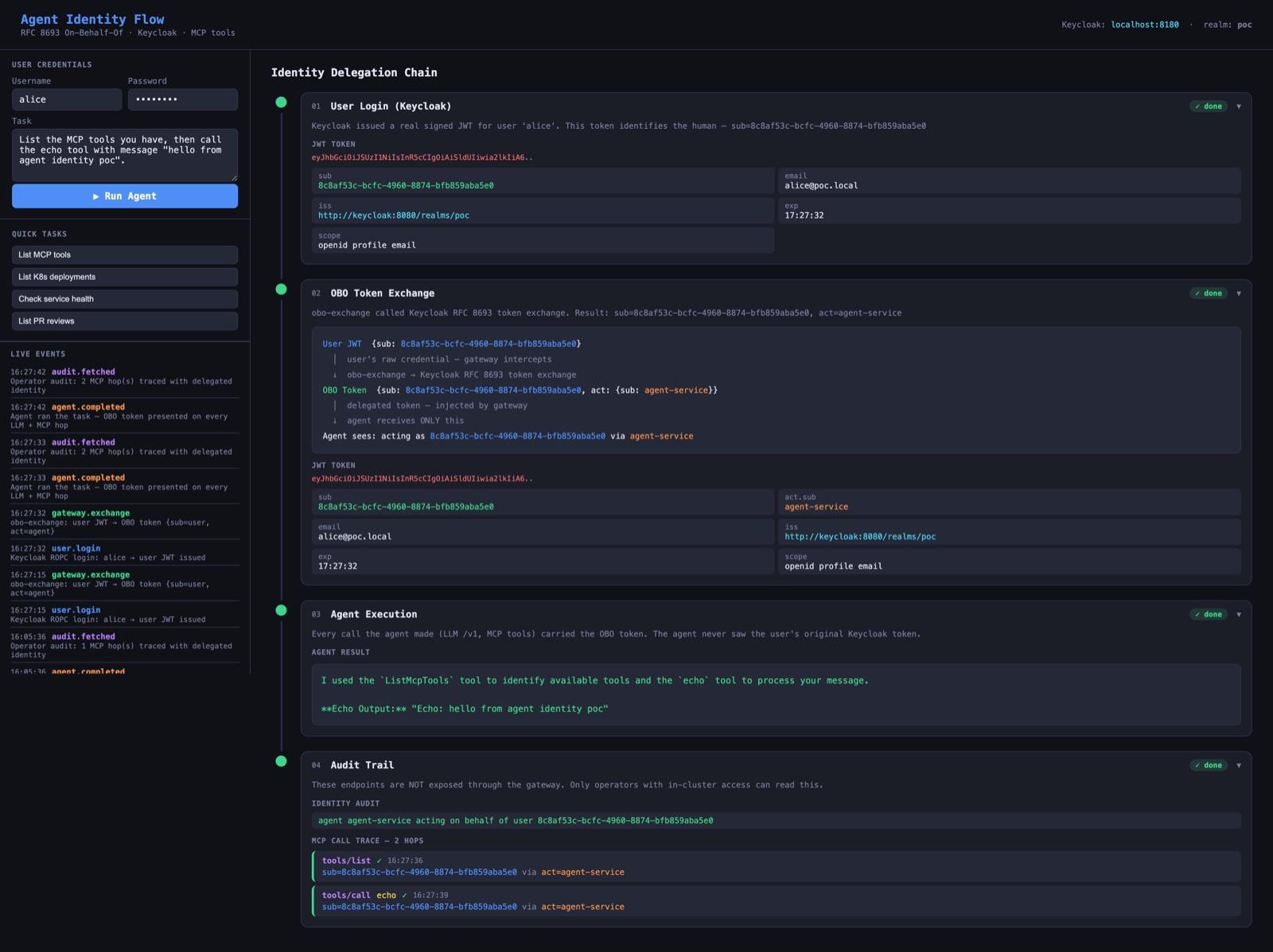
Table of Contents
- Introduction
- The Problem: agents are anonymous proxies
- Enter RFC 8693: Token Exchange, On-Behalf-Of
- The Architecture
- The Identity Flow, Step by Step
- Token Anatomy
- Inside the JWT: Claims, Exchange Mechanics, Group-Based Permissions
- Where Authorization Actually Happens
- Observability: Watching Delegation Happen
- Security Properties
- Conclusion
- Reflections
Here we are. Everyone is wiring AI agents to real systems — Kubernetes clusters, CI pipelines, internal APIs — and almost nobody is asking the boring question first: when the agent calls a tool, who is it?
Introduction
I’ve been playing with MCP tool servers and agentic loops for a while, and there was one thing that made me crazy: every downstream system sees the agent’s service account. Always. The human who asked for the task disappears at the first hop.
So I built a small, fully local POC to answer one question: can every hop of an agentic workflow — the LLM proxy, every single MCP tool call — carry both identities, the human and the agent, in a token that’s cryptographically real and independently verifiable?
Spoiler: yes. The standard has existed since 2020. It’s RFC 8693 Token Exchange, and Keycloak speaks it out of the box.
In this article, I’ll walk you through the architecture: a broker that exchanges the user’s token for a delegated one, an agent that never sees the user’s raw credential, and an audit trail that can finally answer “what did alice actually do through this agent?”
Everything runs in Docker on localhost — no cloud, no VPN, no TLS ceremony. Keycloak, a Python broker, a FastAPI agent, LiteLLM, a mock MCP server, Redis — plus Prometheus and Grafana, because a delegation chain you can’t observe is a delegation chain you can’t trust.
The Problem: agents are anonymous proxies
The classic setup: alice logs into some portal, submits a task, an agent picks it up and starts calling tools with its own service-account credentials. Every MCP call arrives as:
{ "sub": "agent-service" }The tool server can answer “is this agent allowed?” — but not “is alice allowed to do this via this agent?” Those are very different questions:
- Permissions: alice can deploy to staging, bob can deploy to prod. With a shared service account, both can do everything the agent can.
- Audit: the action is attributed to a generic service account. Good luck with that during an incident review.
- Revocation: alice leaves the company, her session dies — but the agent keeps running with its own credentials, hours later.
- Rate limiting: per-agent quota instead of per-user quota. One noisy user starves everyone.
Could you just pass alice’s access token straight to the agent? Naaaa… Now the agent holds a raw user credential, can impersonate her fully (not just for this task), and you’ve built a credential-leaking machine with a tool-calling loop attached.
Enter RFC 8693: Token Exchange, On-Behalf-Of
RFC 8693 defines a standard OAuth2 grant where a trusted party exchanges one token for another. In the On-Behalf-Of (OBO) variant, the exchange takes the user’s token as subject and a service identity as actor, and mints a new JWT carrying both:
{
  "sub": "8c8af53c-...",              // the human (alice)
  "act": { "sub": "agent-service" },  // the agent acting for her
  "iss": "http://localhost:8180/realms/poc"
}
**sub** = who owns the action. **act.sub** = who is executing it. Every downstream system that validates this token can enforce rules on both — and it’s a real RS256 JWT signed by Keycloak, not something the gateway invented.
The Architecture
Nine containers, all local:
| Port | Container | Role |
|---|---|---|
| 8180 | poc-keycloak | Real IdP (Keycloak 24), runs the RFC 8693 exchange |
| 8081 | poc-obo-exchange | OBO broker — sole holder of the exchange client secret |
| 8082 | poc-agent | AI agent: tool-calling loop, grant store, audit endpoints |
| 8083 | poc-mcp-mock | MCP Streamable HTTP server with 4 demo tools |
| 4000 | poc-litellm | OpenAI-compatible LLM proxy (Ollama / OpenAI / Anthropic) |
| 8080 | poc-webapp | Identity-flow visualizer (simulates the gateway) |
| 6379 | poc-redis | Grant store, AES-256-GCM encrypted at rest |
| 9090 | poc-prometheus | Metrics — scrapes every service + Keycloak + Redis |
| 3000 | poc-grafana | Two auto-provisioned dashboards (delegation flow, service RED) |
Three Keycloak clients define the trust topology:
poc-webapp          public PKCE app     ← human logs in here
agent-service       service account     ← the agent's own identity (actor)
exchange-app        confidential        ← holds the skeleton key; runs RFC 8693
The design choice I care most about: the exchange-app client secret — the skeleton key that can mint delegated tokens for any user — lives in exactly one small, auditable service: the obo-exchange broker. The agent never touches it. If it isn’t there, it can’t leak.
OBO the pattern vs obo-exchange the service
Two easily-confused names, worth separating:
- OBO is a pattern, not software: “On-Behalf-Of”, the RFC 8693 flow where a user token is exchanged for a delegated token
{sub=user, act=agent}. It’s an OAuth2 grant type (urn:ietf:params:oauth:grant-type:token-exchange), and the exchange itself is performed by Keycloak. - obo-exchange is the small application that brokers it — ~330 lines of FastAPI. It mints nothing itself; its whole job is three things: hold the
exchange-appsecret (the only container that has it), call Keycloak (/exchangeand/refresh,actpreserved), and serve/authzfor a gateway’s extAuth filter.
It’s small on purpose: zero business logic means easy audit and minimal attack surface, and in Kubernetes a tight NetworkPolicy (only the gateway and the agent may reach it). You can remove the service entirely — gateway extAuth talking to Keycloak directly, or clients calling Keycloak themselves with standard token exchange v2 (Keycloak 26.2+). The dedicated broker stays the right choice when you want the secret in exactly one place and centralized audit of every exchange.
The full component map:
The Identity Flow, Step by Step
Four things worth noticing:
- The user JWT stops at the gateway. What crosses into the agent backend is only the delegated token.
- The agent stores the grant encrypted at rest (AES-256-GCM in Redis), keyed by run id.
- The OBO token is short-lived (1h) but comes with a rotating refresh token — the broker can renew it offline, so a long-running task survives without the human being present. The
actclaim is preserved across refreshes. One Keycloak gotcha here: when you ask the exchange forrequested_token_type=access_token, Keycloak omits the refresh token entirely — the broker has to request therefresh_tokentype (withoffline_accessin scope) or long-running renewability silently doesn’t exist. - Operator-only audit endpoints reconstruct everything after the fact:
curl http://localhost:8082/admin/instances/$RUN_ID/identity | python3 -m json.tool
curl http://localhost:8082/admin/instances/$RUN_ID/trace    | python3 -m json.tool
The logs alone are already worth the exercise:
[OBO] run=abc123 sub=8c8af53c act=agent-service has_refresh=True
[MCP] run=abc123 tools/call sub=8c8af53c act=agent-service ok=True
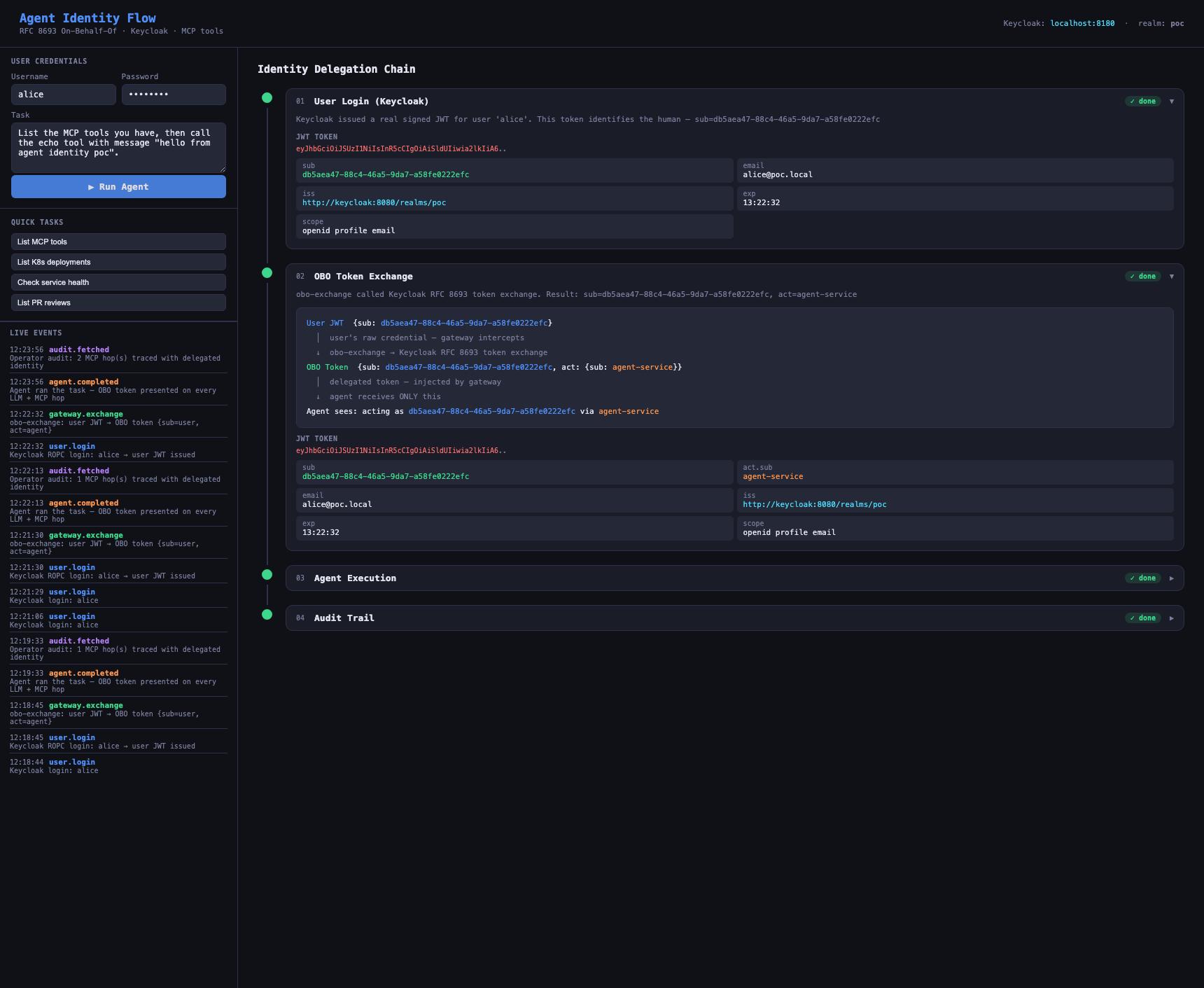
The webapp visualizes the whole chain live — login, exchange, agent run, audit — with every JWT decoded on screen. In Step 2 you can see the exchange result: same sub as the user token, act.sub=agent-service, and iss pointing at the realm — a real RS256 exchange performed by Keycloak, not a local shortcut (more on that below):
Token Anatomy
User JWT, straight from Keycloak login:
{
  "sub":   "8c8af53c-bcfc-4960-8874-bfb859aba5e0",
  "aud":   "exchange-app",
  "iss":   "http://localhost:8180/realms/poc",
  "email": "[email protected]"
}
OBO token, minted by Keycloak via RFC 8693:
{
  "sub":   "8c8af53c-bcfc-4960-8874-bfb859aba5e0",
  "act":   { "sub": "agent-service" },
  "iss":   "http://localhost:8180/realms/poc",
  "scope": "openid profile email"
}
Same sub, same issuer, same signature chain — plus the act claim. Any service with the realm’s public key can verify it independently. No shared secrets between tool servers and the gateway, no “trust me, it’s alice” headers.
Inside the JWT: Claims, Exchange Mechanics, Group-Based Permissions
The sub + act pair is the headline, but the rest of the token is where per-user authorization actually comes from. Let’s open it up.
Three parts, one signature
A JWT is three base64url segments joined by dots: header.payload.signature.
// header — tells the verifier HOW to check the token
{ "alg": "RS256", "typ": "JWT", "kid": "f3a1..." }
The header’s kid (key id) points at one of the realm’s public keys, published at a well-known URL:
http://localhost:8180/realms/poc/protocol/openid-connect/certs ← JWKSThe signature covers header + payload, made with Keycloak’s private key. Anyone can fetch the JWKS and verify; only Keycloak can sign. That asymmetry is the entire trust model: the MCP server never needs a shared secret with the gateway, it needs one HTTP GET.
Two properties people mix up: a JWT is stateless (any service verifies it offline, no call to Keycloak) but it is not encrypted — it’s just base64. Anyone holding the token reads every claim. Never put secrets in claims.
The claims that matter
| Claim | Set by | What it does in this flow |
|---|---|---|
iss | Keycloak | Which realm minted it. Verifiers reject any other issuer. |
sub | Keycloak | Stable user UUID — not the username, which can change. This is the audit anchor. |
aud | Keycloak | Who the token is for. The user token says exchange-app; the OBO token can be re-audienced per resource server. Verifiers reject tokens not addressed to them. |
azp | Keycloak | Which client requested it (authorized party). Also how the broker derives a readable actor name: the actor token’s sub is a UUID, its azp is agent-service. |
exp / iat | Keycloak | Lifetime. OBO tokens are short-lived (1h); long tasks live on the refresh token, not on a long exp — the agent refreshes when now >= exp - 60s. |
jti | Keycloak | Unique token id — revocation lists and replay detection key on it. |
scope | negotiated | What kind of operations the token allows (openid profile email, later mcp:read / mcp:write). Exchange can only narrow scope, never widen it. |
act | RFC 8693 | The actor. Nests on repeated exchange: act.act records a delegation chain (agent A delegates to agent B — the whole lineage stays in the token). |
realm_access.roles | role mappings | The user’s realm roles — the input for per-tool RBAC. |
groups | protocol mapper | Group membership emitted as a claim — the bridge from AD (next section). |
What the exchange actually does with these fields
The broker’s call to Keycloak, unwrapped:
curl -s http://localhost:8180/realms/poc/protocol/openid-connect/token \
  -d grant_type=urn:ietf:params:oauth:grant-type:token-exchange \
  -d client_id=exchange-app \
  -d client_secret=$EXCHANGE_SECRET \
  -d subject_token=$USER_JWT \
  -d subject_token_type=urn:ietf:params:oauth:token-type:access_token \
  -d requested_token_type=urn:ietf:params:oauth:token-type:refresh_token \
  -d audience=agent-service \
  -d scope="openid offline_access"
Keycloak then:
- Verifies the subject token — its own signature,
expnot passed,issis itself,audincludesexchange-app. An expired or foreign user token means no exchange: delegation dies with the session. - Checks the exchange permission —
exchange-appmust be explicitly allowed to exchange toward the target client. That’s the fine-grained authz permissionsetup.shconfigures; without it Keycloak returns 403 regardless of the secret. - Mints a new token —
sub,email, roles and groups are re-read from the user model at mint time (not copied blindly from the subject token — disable the user and the next exchange fails),actis injected from the actor identity,audis rewritten,scopeis intersected with what was requested, freshexp.
That third point is subtle and important: because claims are re-derived at every exchange and refresh, revoking a role or disabling a user propagates within one token lifetime — no “the agent still has a 30-day-old token with admin roles” scenario.
From AD group to token claim
None of this works in an enterprise unless it plugs into the directory you already have. The chain is:
AD / Entra ID group  →  Keycloak group  →  realm role  →  JWT claim
  "GG-Platform-Admins"    /platform-admins    platform-admin   realm_access.roles
Two standard ways to wire the first arrow:
- LDAP user federation — Keycloak reads AD directly; an ldap group mapper imports AD groups as Keycloak groups on sync.
- Identity brokering — login is delegated to Azure AD / Entra via OIDC or SAML, and the incoming
groupsclaim is mapped through an identity-provider mapper.
Then a group-to-role mapping (or a plain protocol mapper emitting the groups claim) makes membership appear in every token — including the OBO token, because as we just saw, claims are re-read from the user model at exchange time. Alice’s OBO token becomes:
{
  "sub": "8c8af53c-...",
  "act": { "sub": "agent-service" },
  "groups": ["/platform-admins", "/db-readers"],
  "realm_access": { "roles": ["platform-admin", "db-reader"] }
}
Remove alice from GG-Platform-Admins in AD and — after the next directory sync + token refresh — every agent acting on her behalf loses platform-admin. The directory team keeps its existing workflow; the agent platform inherits it for free.
From claims to tool permissions
Now the payoff: the MCP server (or any resource server — a DB proxy, an API gateway) reads those claims and enforces per-tool policy. A permission matrix stops being architecture and becomes a lookup:
| Tool | Requires |
|---|---|
query_database (read-only) | role db-reader |
execute_sql (write) | role db-writer and HITL approval |
call_billing_api | group /billing-team and scope mcp:write |
delete_deployment | role platform-admin |
TOOL_POLICY = {
    "query_database":    {"roles": {"db-reader"}},
    "execute_sql":       {"roles": {"db-writer"}, "hitl": True},
    "call_billing_api":  {"groups": {"/billing-team"}, "scopes": {"mcp:write"}},
    "delete_deployment": {"roles": {"platform-admin"}},
}

def authorize(tool, claims):
    policy = TOOL_POLICY.get(tool, {})
    roles  = set(claims.get("realm_access", {}).get("roles", []))
    groups = set(claims.get("groups", []))
    scopes = set(claims.get("scope", "").split())
    if policy.get("roles") and not policy["roles"] & roles:
        raise PermissionError(
            f"{tool}: needs role {policy['roles']}, sub={claims['sub']} has {roles}")
    if policy.get("groups") and not policy["groups"] & groups:
        raise PermissionError(f"{tool}: needs group {policy['groups']}")
    if policy.get("scopes") and not policy["scopes"] <= scopes:
        raise PermissionError(f"{tool}: needs scope {policy['scopes']}")
    return policy.get("hitl", False)   # caller pauses for approval if True
Two things make this pattern stronger than app-level ACLs:
- The same claims work everywhere. A Postgres proxy can key row-level security on
sub; an internal API gateway can requiregroups; the MCP server gates tools on roles. One identity, one policy language, enforced at N independent points — and every denial logs which human, via which agent, was refused what. - Per-task narrowing. The broker can mint the OBO token with
audience=mcp-dbandscope=mcp:readfor a reporting task, and the same user getsmcp:writeonly for a deployment task. The blast radius of a compromised agent run is the intersection of user roles × task scope × token audience, not the union of everything the platform can do.
⚠️ Corollary: anything in the chain that ignores the token breaks the model. An LLM response cache keyed only on the prompt would happily serve alice’s cached answer to bob. If you add caching anywhere in an identity-carrying pipeline, the cache key must include
sub.
Where Authorization Actually Happens
Knowing who alice is doesn’t mean she can run every tool. The token is the transport; enforcement happens at independent layers, and each one reads the same two claims:
Layer 1 — Gateway PDP. CEL rules on the JWT before the request touches any tool server. In production this is agentgateway (Envoy-based) with an extAuth filter:
- path: /mcp
  policy: jwt.realm_access.roles.exists(r, r == "ai-platform-user")
Layer 2 — MCP server per-tool checks. The tool server receives the full OBO token and can gate sensitive tools on alice’s roles:
SENSITIVE_TOOLS = {"delete_deployment", "apply_terraform", "merge_pr"}

def _exec_tool(name, arguments, claims):
    if name in SENSITIVE_TOOLS:
        roles = claims.get("realm_access", {}).get("roles", [])
        if "platform-admin" not in roles:
            raise PermissionError(
                f"tool '{name}' requires platform-admin — "
                f"sub={claims['sub']} has roles={roles}"
            )
Layer 3 — Scope negotiation at exchange time. Mint the OBO token with mcp:read but not mcp:write, and the tool server refuses writes regardless of roles.
Layer 4 — Human-in-the-Loop. For tools that are sensitive no matter who asks, the workflow pauses, notifies the human, and resumes only on explicit approval:
agent wants to call: delete_namespace
↓ HITL gate: pause workflow
↓ human sees notification → approve / reject
↓ approve: tool runs — reject: LLM is told "call was rejected"
The end-to-end picture, when everything is on:
Observability: Watching Delegation Happen
The first version of this POC had a problem I only saw after a critical review pass: the broker had a fail-open path. If Keycloak returned non-200 on the exchange — outage, misconfiguration, even an invalid subject token — the broker silently fell back to a locally-signed HMAC token that looked like a valid delegated token. The system degraded to a weaker trust model and nobody was forced to notice.
The fix has two halves, and the second one is the interesting one:
- The fallback is now gated behind
ALLOW_LOCAL_FALLBACK—truelocally for demo ergonomics,falsein the Kubernetes deployment, where a Keycloak failure means a failed exchange, full stop. Fail closed. - Every exchange outcome is counted:
obo_exchange_total{result="ok|fallback|error"}. A security downgrade you can’t measure is a security downgrade you’ll discover during the incident.
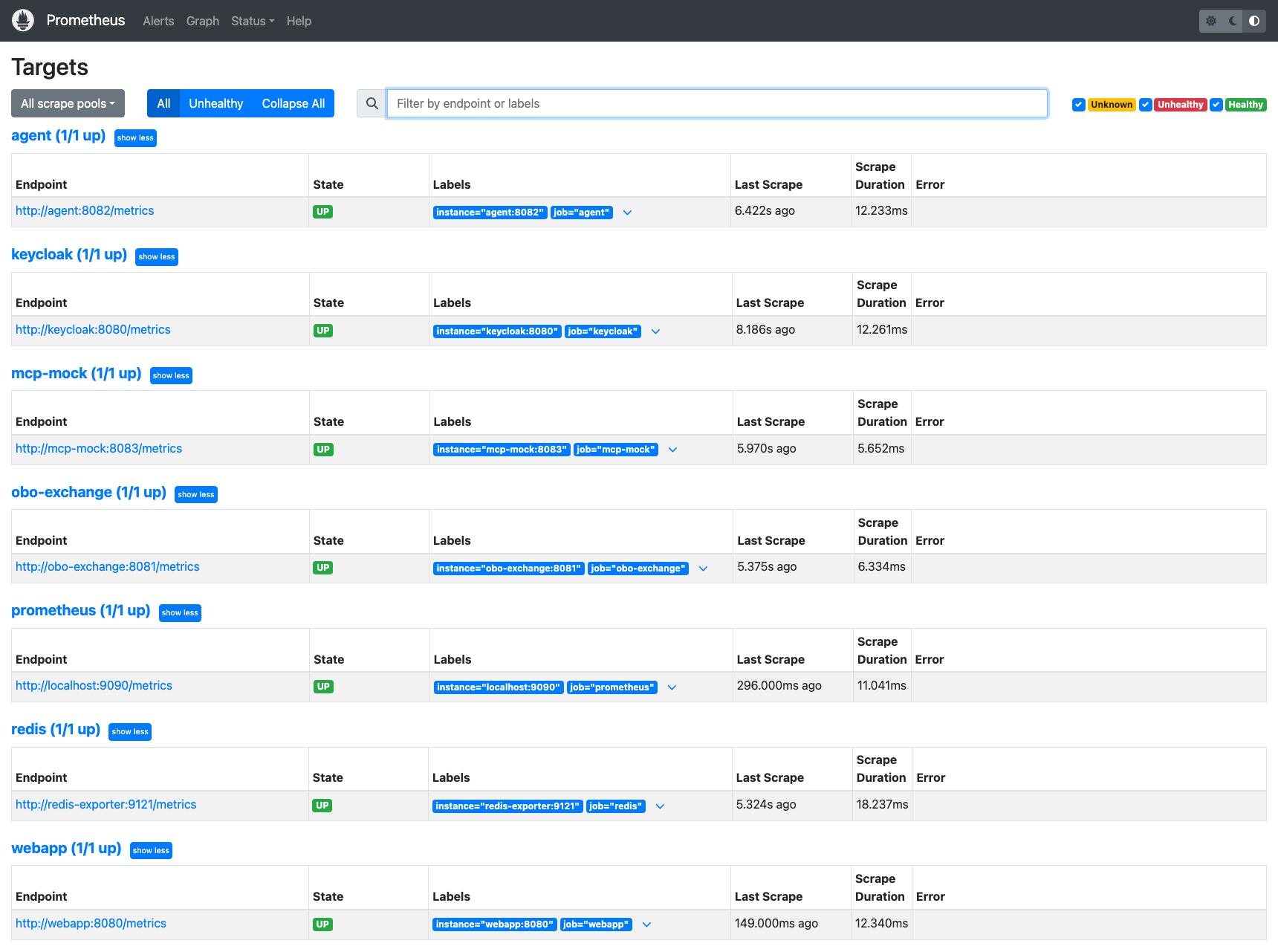
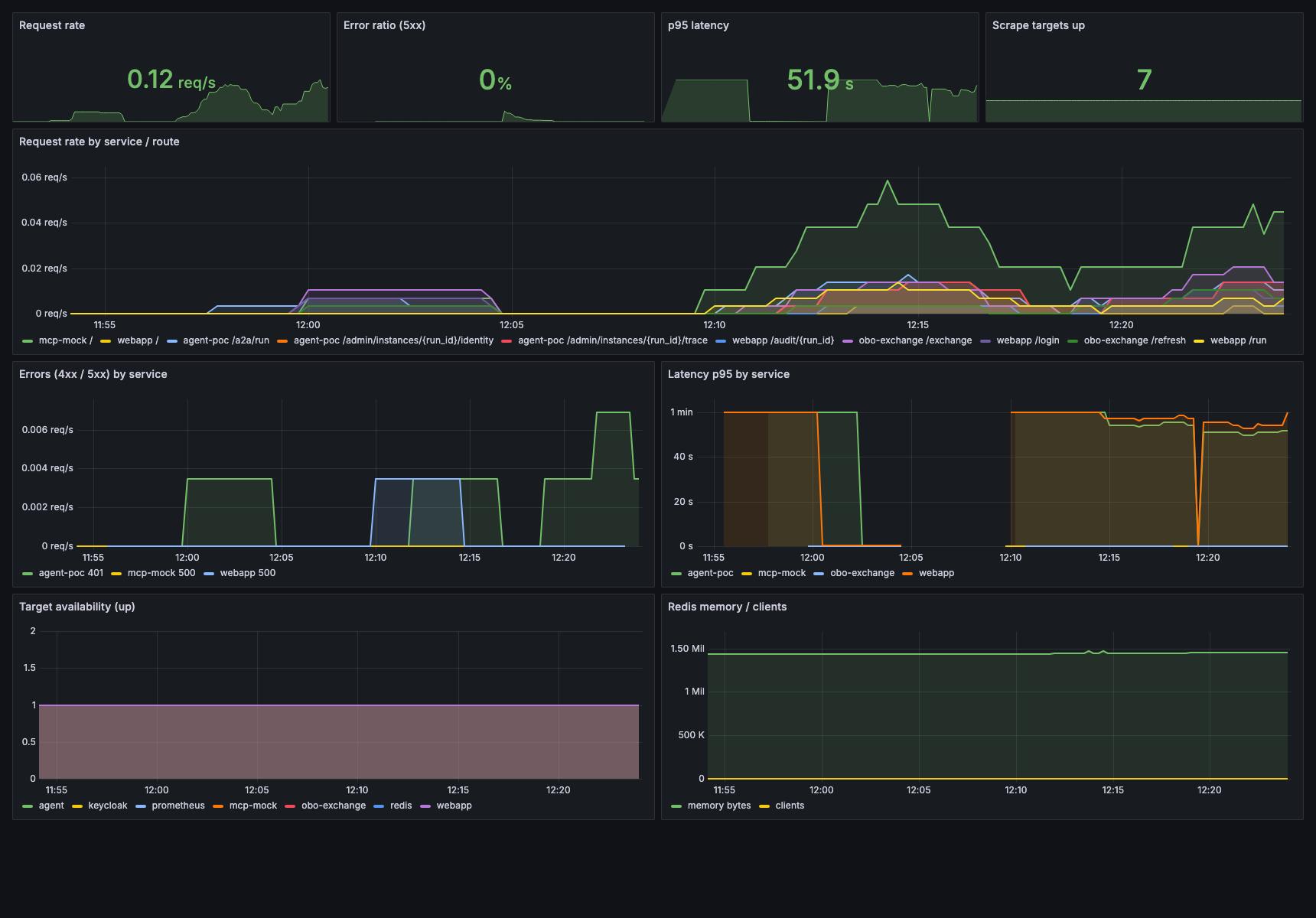
Every Python service exposes /metrics (RED per route plus domain metrics: agent_runs_total{status}, agent_mcp_requests_total{tool}, mcp_tool_calls_total, webapp_flows_total{fallback}), /healthz and /readyz. Prometheus scrapes all seven targets — the four Python services plus Keycloak (KC_METRICS_ENABLED=true), Redis via redis_exporter, and itself — and Grafana ships two auto-provisioned dashboards:
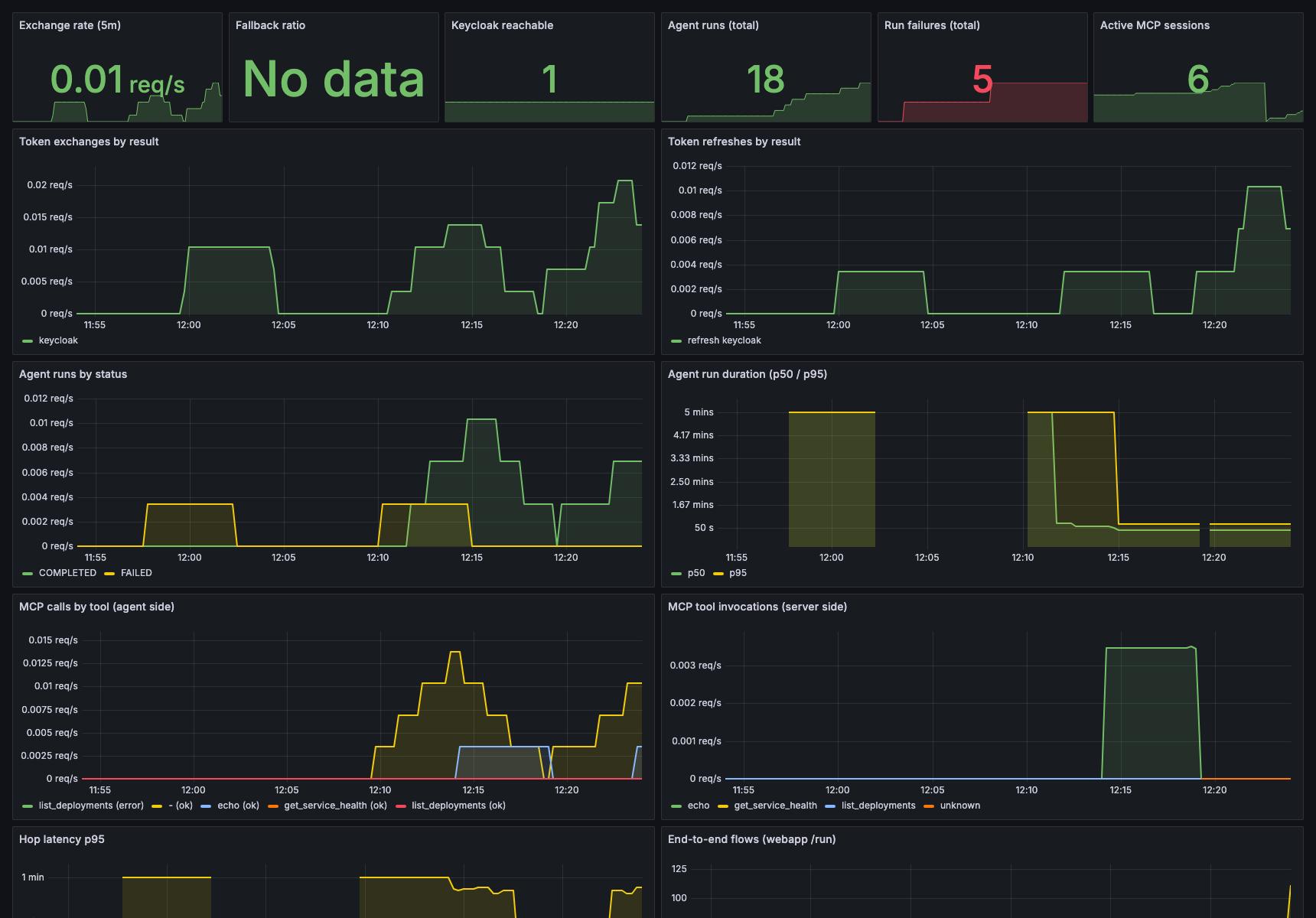
The Delegation Flow dashboard is the one that matters: exchange rate, fallback ratio (in the screenshot it reads “No data” — zero fallback samples, which is exactly what healthy looks like; any nonzero value turns it red, meaning Keycloak stopped doing real RFC 8693 and the broker is minting demo tokens), Keycloak reachability, run outcomes, token refreshes, per-tool MCP traffic on both the agent and server side, hop latencies:
The Service RED dashboard covers rate / errors / duration per service, plus scrape-target availability and Redis memory — the boring one you look at when something is slow. Look at the errors panel: those webapp 500 and mcp-mock 500 spikes are exactly the latent defects described below, caught on camera:
The dashboards paid for themselves within hours
This is the part I want to insist on. Four latent defects became visible that log-grepping had never surfaced:
- The E2E test was silently exercising the HMAC fallback on every run. The fallback-ratio stat sat at 50% and pointed straight at it: the test passed the user JWT where the actor token belonged, and — bonus finding — dev-mode Keycloak derives the token
issfrom the request Host header, so tokens minted vialocalhost:8180get rejected asinvalid_tokenby the in-network exchange atkeycloak:8080. The test now logs in through the internal issuer and fails when the exchange degrades. - Real RS256 grants were not renewable. Only the fallback tokens carried a refresh token (see the Keycloak gotcha above) — the POC’s core “renewability” property worked only on the degraded path. Ouch.
- The webapp returned 500 on agent timeout under concurrent runs — unhandled
httpx.ReadTimeout, now a clean 504/502. - The MCP server crashed on
"params": null— LLM-driven JSON-RPC clients send explicit nulls, and.get(k, {})does not cover them.
Number 1 and 2 are the humbling ones: the system looked like it was demonstrating real RFC 8693 delegation, and half the time it was demonstrating a locally-signed simulation of it. No log line said so. A single red ratio stat did.
And because “it works on my laptop” is not a claim, there’s a test pyramid — ./scripts/test-flow.sh, unit → integration → E2E, 31 checks with the stack up. The key assertions: fallback=False on the real exchange, and the metrics counters actually incrementing after the E2E run.
Security Properties
- The agent never sees the user’s raw credential — only the delegated OBO token, scoped to this task.
- The exchange secret is held by one small broker — the skeleton-key pattern. Compromising the agent doesn’t give you token-minting power.
- Grants are encrypted at rest — AES-256-GCM in Redis; token material never sits in plaintext.
- Tokens are real RS256 JWTs signed by Keycloak — verifiable by anyone with the realm public key, forgeable by no one.
- Every MCP call is traced with the identity it presented — audit is a query, not an archaeology project.
- Revocation works — alice’s session ends, her
subbecomes unauthorized, and in-flight tool calls fail closed. - The trust downgrade path is gated and measured — the local-token fallback is off in production (
ALLOW_LOCAL_FALLBACK=false) and alertable via theobo_exchange_total{result="fallback"}metric when it’s on.
Conclusion
Agent identity is not an exotic problem requiring an exotic solution. RFC 8693 has been sitting there since 2020, Keycloak implements it, and the whole delegation chain — login, exchange, agent run, LLM call, MCP call, audit, dashboards — fits in nine containers on a laptop. When the laptop stops being enough, there’s a Helm chart (helm/agent-identity-poc) where every component is optional and externally wireable: point it at your existing Keycloak and Redis, swap LiteLLM for your LLM gateway, and the defaults fail closed, run non-root with a read-only rootfs, and ship HPAs for the broker and the agent. The sub + act pair turns “is this agent allowed?” into “is this user allowed to do this via this agent?”, which is the question your security team actually wants answered. If you’re wiring agents to real infrastructure, put the identity plumbing in before the agents get interesting.
Reflections
Intellectual honesty time: this POC demonstrates identity transport, not enforcement.
What is verified: the token reaching MCP really carries sub=alice act=agent-service, the agent never holds alice’s raw token, every call is traced and now measured. An EA/SRE critical review pass (docs/CRITICAL_REVIEW.md) already forced a round of fixes: the fail-open HMAC fallback is gated and counted, the trace store is an atomic Redis list (concurrent tool calls were losing audit entries to a read-modify-write race — an audit trail that loses entries under load is worse than none, it lies), Redis is a readiness dependency (/readyz), so a replica that loses it stops receiving traffic instead of silently splitting state, and the broker went fully async — one slow Keycloak round-trip no longer stalls every in-flight exchange. What is still missing?
- Downstream services don’t verify the RS256 signature — agent, MCP server and webapp decode the JWT without checking it against Keycloak’s JWKS. The audit trail records claimed identity, not proven identity. This is the highest-value next increment.
- The gateway is simulated by the webapp — no real CEL policy on
/mcp. Production wants agentgateway with an extAuth filter. - The MCP server logs
subandactbut blocks nothing. The per-tool role check above is a code sketch, not shipped behavior. - No custom
mcp:read/mcp:writescopes yet — the OBO token carries plainopenid profile email. - HITL is disabled (
ENABLE_HITL=0). The durable-workflow pause/resume exists as stubs. - Login uses ROPC (password grant) for demo simplicity — production means PKCE in a browser, plus mTLS everywhere (the refresh token travels in a custom header, which is only acceptable on a local bridge network).
- Keycloak’s token exchange here is the legacy preview feature (
KC_FEATURES=token-exchange); Keycloak 26.2+ ships standard v2 token exchange, which would remove most of the permission-bootstrap fragility insetup.sh.
Each gap is deliberate: transport first, because without sub=alice in the token, no enforcement layer has anything to enforce. The enforcement layers are the fun part — and they’re all one if statement away once the identity is there.
If this topic touches your stack, you may also like Stargate LLM Gateway — the production-side LLM gateway story this POC plugs into.