Patch Once, Rebuild Everywhere: A Distroless Base Image Pipeline
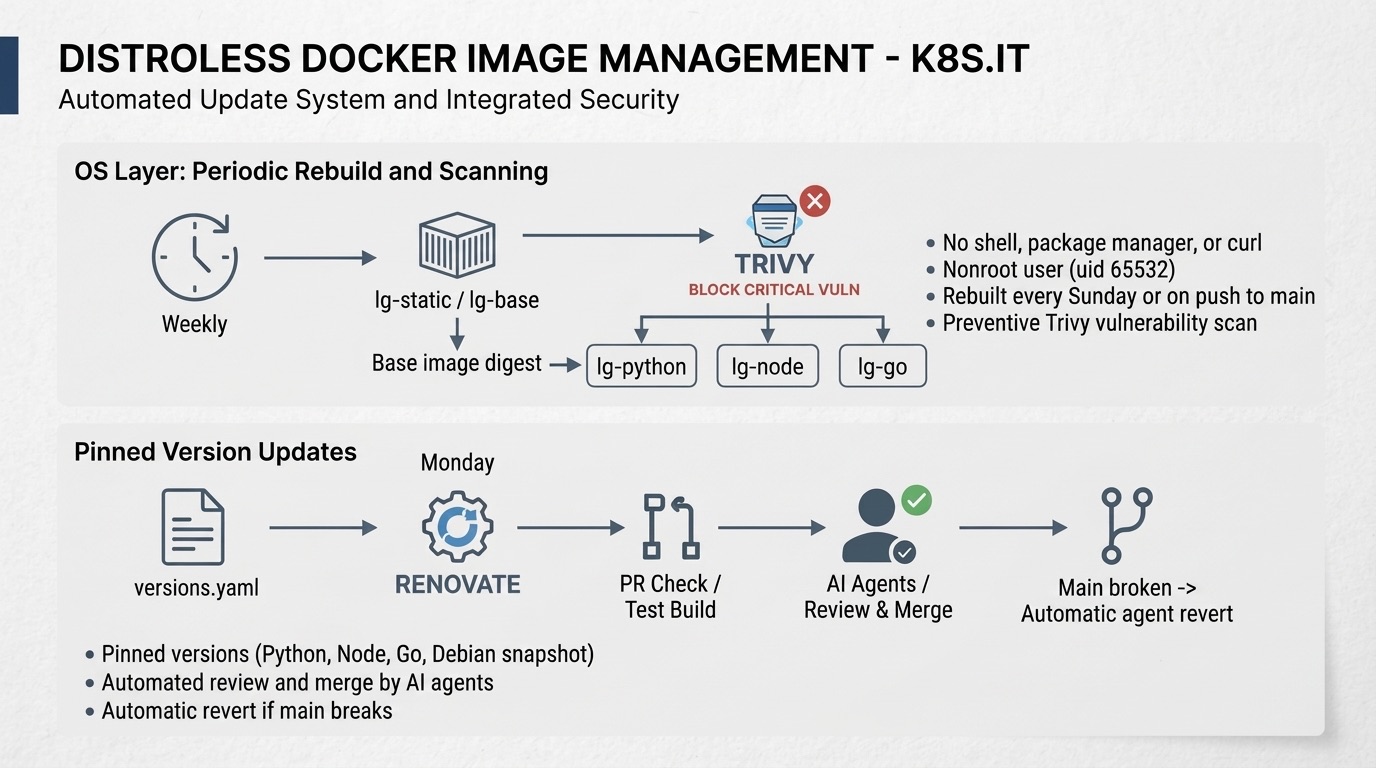
Table of Contents
- The Problem: N containers, one CVE
- What I Had
- Naaa… the alternatives
- The Idea: Layers That Patch Themselves
- Building a Distroless Base Without Google
- The Single Source of Versions
- The Cascade
- Trivy as the Gate
- Who Keeps It Alive: Renovate and the Agents
- The Test: pytbak on the New Base
- What Broke on the Way
- Security Considerations
- Monitoring and Observability
- Conclusion
- Reflections
Here we are.
Last week I scanned pytbak, my debug/test API, with Trivy. The release I had been running for a long time, lgirardi/pytbak:v2.0.3, sat on Debian 12.9 and the report said 842 vulnerabilities, 16 of them CRITICAL. So I did the obvious thing: I updated. New release, v2.0.425, rebuilt on the current public python:3.15.2-slim (Debian 13.7). The count dropped to 444, 4 of them CRITICAL. Better, and still not good.
The application code had nothing to do with it. Almost all of it was the operating system sitting underneath: 808 findings in Debian packages for the old image and 436 for the updated one, packages the app never calls, plus a few dozen in Python dependencies. And here is the uncomfortable part: that update was a one-off. It is a snapshot of today, and in a month it will have rotted again, exactly like v2.0.3 did.
Now multiply that by the number of containers you run. I have a handful in the homelab. A company has hundreds. Every one of them carries its own copy of the same glibc, the same OpenSSL, the same tzdata, and every one of them needs a rebuild the day one of those gets a CVE. That is the real problem of this post: not “how do I make one image smaller”, but how do I patch the operating system of many containers without touching each one by hand.
The Problem: N containers, one CVE
Think about what happens when OpenSSL publishes a fix.
- Debian ships the patched package.
- Nothing happens to your running containers. They still have the old copy baked in.
- Somebody has to rebuild every image, and every rebuild has to pick up the new package.
If each service has its own Dockerfile with FROM python:3.15.2-slim and its own apt-get install, step 3 is N separate decisions. Some will be forgotten. Some will be rebuilt from a cached layer that still has the old package. And you find out which ones when the next scan runs.
The fix is not a better scanner. The fix is to move the operating system out of the applications into one place that is rebuilt on a schedule, and let the applications inherit from it.
What I Had
I already had a repository for this, ACT-lg-baseimg, with a base/ image on debian:bookworm-slim and a flask/ image on top of it. Built every Sunday. The idea was right. The execution had aged:
python3=3.11.2-1+b1, pinned through apt: an old Python, and an exact apt pin that breaks the build the day Debian updates that package.- A missing
&&in aRUN, so the linerm /usr/lib/python3.11/EXTERNALLY-MANAGEDended up as an argument of the previousrm -rfand never ran. - One mutable tag,
:edge. No dated tags, so no rollback. procps,lsof,net-toolsin the base: handy for debugging, but they are attack surface in production.- A workflow with an invalid
run:input and a digest output that was always empty.
Still a shell, still apt, still dpkg, in every container that inherited from it.
Naaa… the alternatives
- Keep the Debian base, just patch it more often. Better, but the image still has a shell and a package manager. Most of the 436 OS findings were in packages the app never touches.
- Alpine. Smaller, but musl instead of glibc. Several Python wheels are missing or have to be compiled. I did not want to trade CVEs for build surprises.
- Google distroless or Chainguard. Good images, but the Python version is whatever they ship, and I want the exact version I chose. Pinned versions on Chainguard are a paid feature, the free tier only gives
:latest. - Build my own distroless layers. More work once, full control after.
Naaaa on the first three. Enter the fourth.
The Idea: Layers That Patch Themselves
Distroless means an image with no shell, no package manager, only what the program needs to run. If it isn’t there, it can’t break. And it can’t be exploited either.
The repository now looks like this:
ACT-lg-baseimg/
├── versions.yaml            # the ONLY place a version is written
├── images/
│   ├── base/Dockerfile      # lg-static and lg-base targets
│   ├── python/Dockerfile    # lg-python on top of lg-base
│   ├── node/Dockerfile      # lg-node on top of lg-base
│   ├── go/Dockerfile        # lg-go: build-stage toolchain
│   └── mkrootfs.sh          # root filesystem from Debian packages
├── scripts/                 # build.sh, test-images.sh, versions.py
└── legacy/ # the old images, still rebuilt weekly| Image | What it is | Size |
|---|---|---|
lg-static | CA certificates, tzdata, nonroot user. No libc | 1.5 MB |
lg-base | lg-static + glibc, libstdc++, OpenSSL | 17 MB |
lg-python | CPython 3.15.2 on lg-base | 54 MB |
lg-node | Node.js 24.22.3 on lg-base | 141 MB |
lg-go | Go 1.27.4, build stage only | 479 MB |
Go needs no runtime image: a program built with CGO_ENABLED=0 runs straight on lg-static. The 479 MB toolchain stays in the build stage and never ships.
The point is the arrows between them, not the sizes:
Building a Distroless Base Without Google
The trick is that a distroless root filesystem is nothing magical: it is the files that a few Debian packages install, copied onto scratch.
images/mkrootfs.sh takes a list of packages, installs them in a throwaway Debian container, and copies only the files each package owns into /rootfs:
for pkg in "$@"; do
  dpkg -L "$pkg" | while IFS= read -r path; do
    [ -f "$path" ] || [ -L "$path" ] || continue    # directories are created on demand
    dir=$(readlink -f "$(dirname "$path")")          # resolve the usr-merge symlinks
    mkdir -p "$R$dir"
    cp -a "$path" "$R$dir/"
  done
  dpkg-query -s "$pkg" > "$R/var/lib/dpkg/status.d/$pkg"
done
Two details matter:
status.drecords. Each package leaves its control file in/var/lib/dpkg/status.d/, the convention distroless uses. Without them an image has no package database and Trivy sees nothing, which looks great in the report and means nothing. With them, the scanner lists what is really inside.- Pruning. glibc ships about 200 character-set converters, 20 MB that no web service uses. I keep the Unicode ones and two Western ones. That alone took
lg-basefrom 35 MB to 17 MB.
The two targets of images/base/Dockerfile differ only by the package list:
FROM debian:${DEBIAN_TAG} AS rootfs-base
COPY images/mkrootfs.sh /usr/local/bin/mkrootfs.sh
RUN mkrootfs.sh base-files ca-certificates tzdata netbase \
                libc6 libgcc-s1 libstdc++6 zlib1g libssl3t64 libzstd1

FROM scratch AS base
COPY --from=rootfs-base /rootfs/ /
ENV SSL_CERT_FILE=/etc/ssl/certs/ca-certificates.crt
USER 65532:65532
WORKDIR /home/nonroot
lg-python does not use Debian’s Python. It copies the official CPython build of the pinned version, so the interpreter is exactly 3.15.2, and strips what a runtime never needs: pip, the test suites, idle, ensurepip.
The Single Source of Versions
This is the part that answers “the versions must be pinned and chosen”. One file, no exceptions:
# versions.yaml
# renovate: datasource=docker depName=debian versioning=regex:^trixie-(?<major>\d{8})-slim$
debian: trixie-20261104-slim

# renovate: datasource=docker depName=python versioning=docker
python: 3.15.2

# renovate: datasource=docker depName=node versioning=node
node: 24.22.3

# renovate: datasource=docker depName=golang versioning=docker
go: 1.27.4
Dockerfiles receive these as build args, workflows read them through a tiny scripts/versions.py. A unit test fails if a runtime is not an exact major.minor.patch, if the Debian tag is not a dated snapshot, or if a line has no # renovate: comment above it. That last test sounds pedantic until you remember that a version Renovate cannot see is a version that rots in silence.
Mind the distinction, because it is the whole design:
- Pinned (changes only through a pull request): the Debian snapshot, Python, Node, Go.
- Floating on purpose (changes on every build): the Debian packages on top of that snapshot, so glibc, OpenSSL, tzdata, the CA bundle. That is what the weekly rebuild is for.
The Cascade
Now the flow I care about. Whenever the base is rebuilt, everything on top of it is rebuilt, on the exact base that was just published.
The runtimes start from the digest of the base, not from :edge:
build-args: |
  BASE_IMAGE=ghcr.io/lorenzogirardi/lg-base@${{ needs.base.outputs.base_digest }}
  PYTHON_VERSION=${{ needs.versions.outputs.python_version }}
A tag moves. A digest does not. So every lg-python is tied to one precise base, the build is reproducible, and if the base fails its scan, the runtimes simply never start.
Tags make the rollback trivial:
| Tag | Moves? | Use it for |
|---|---|---|
lg-python:3.15 | with every patch | development |
lg-python:3.15.2 | with every weekly rebuild | staging |
lg-python:3.15.2-20261121 | never | production |
In production I pin the dated tag, or the digest. Adopting a new base becomes my decision, and going back is a one-line change.
Trivy as the Gate
Every image is built once for amd64, scanned, and only if the scan passes is it built for amd64 and arm64 and pushed with SBOM and provenance. The gate is a composite action, used by every image:
- name: Trivy gate (CRITICAL with a fix available blocks the publish)
  uses: aquasecurity/trivy-action@ed142fd0673e97e23eac54620cfb913e5ce36c25 # v0.36.0
  with:
    image-ref: scan/${{ inputs.name }}:ci
    scanners: vuln
    severity: CRITICAL
    ignore-unfixed: true
    exit-code: '1'
Why ignore-unfixed? Because a gate that blocks on something nobody can fix is a gate people learn to bypass. A vulnerability with no patch cannot be solved by rebuilding. A vulnerability with a patch can, so that one stops the line. Everything else, every severity, goes into the run summary as awareness.
Who Keeps It Alive: Renovate and the Agents
A repository that needs a human to remember it will be forgotten by February. So the maintenance is automated in two layers.
Renovate, every Monday morning, reads versions.yaml through a regex manager and opens pull requests:
| Update | What happens |
|---|---|
| Patch of Python, Node or Go | One grouped PR, no approval needed |
| Minor or major of a runtime | Waits on the Dependency Dashboard until I tick the box |
| Odd Node major | Never proposed, LTS only |
| Debian snapshot | PR for the next dated tag |
| GitHub Actions | One grouped PR, pinned by digest |
Renovate merges nothing itself. The merge authority is the second layer.
The agent pipeline, the same one I use for pytbak, lives in a shared repository (ci-shared, tag v3) and is wired into this repo with a handful of small workflow files:
- every pull request, Renovate’s included, gets an architect’s brief, a developer, a second developer, QA, SRE and security roles, and one comment;
- when
PR Checksfails, an agent reads the real logs and pushes a fix to the branch, three attempts at most; - when the PR is certified and the checks are green, it is squash-merged;
- if the build on
mainbreaks after a merge, a guard reverts it, with a circuit breaker after three reverts in 24 hours.
PR Checks itself is deterministic: it builds all five images, in cascade order, with the same script I run on my laptop, then runs smoke tests. Because a distroless image has no shell, each runtime is tested by running the runtime itself:
out=$(docker run --rm lg-python:local -c "import sys; print('.'.join(map(str, sys.version_info[:3])))")
[ "$out" = "$PYTHON_VERSION" ] || fail "lg-python is $out, pinned $PYTHON_VERSION"
docker run --rm lg-python:local -c "
import ssl, sqlite3, ctypes, zlib, bz2, lzma, uuid, decimal, hashlib, pyexpat, zoneinfo
ssl.create_default_context().load_default_certs()
print('ok')" | grep -qx ok || fail "an extension module or certificate is missing"
That second block is not decoration. It is the reason the next section is a short one instead of a night of production debugging.
The Test: pytbak on the New Base
Theory is cheap. I took pytbak, multi-stage, dependencies installed on python:3.15.2-slim-trixie into a venv, venv copied onto lg-python:
FROM python:3.15.2-slim-trixie AS build
RUN python -m venv /venv
COPY requirements.txt .
RUN /venv/bin/pip install --no-cache-dir -r requirements.txt

FROM lgirardi/lg-python:3.15.2
COPY --from=build /venv /venv
COPY --chown=65532:65532 app/ /app/app/
WORKDIR /app
ENTRYPOINT ["/venv/bin/python", "-m", "uvicorn"]
CMD ["app.main:app", "--host", "0.0.0.0", "--port", "8000"]
Started next to PostgreSQL and Redis, the log said what I wanted to read:
Startup complete | pg=connected redis=connected env=development/api/mgmt/ready, /api/mgmt/health and /metrics all answered 200. Then I ran Trivy on the three images: the old release, the manually updated one and the new one on lg-python:
v2.0.3 (old) | v2.0.425 (updated by hand, python slim) | pytbak on lg-python (workflow) | |
|---|---|---|---|
| Image size | 323 MB | 356 MB | 241 MB |
| Base | Debian 12.9 | Debian 13.7 | Debian 13.8 |
| OS packages | 808 | 436 | 74 |
| Python packages | 34 | 8 | 8 |
| CRITICAL | 16 | 4 | 0 |
| HIGH | 261 | 125 | 15 |
| MEDIUM | 333 | 148 | 45 |
| LOW | 232 | 167 | 22 |
| Total | 842 | 444 | 82 |
All three scans were run with the same command (trivy image --scanners vuln, every severity) on the same day, so the Trivy database is the same for all of them.
Read the three columns as three stages of the same story:
v2.0.3: the old image. Nobody decided to leave it there, it just stayed. 842 findings, 16 CRITICAL.v2.0.425: the manual update, new release on the current publicpython:slim. The same code and the samerequirements.txtas the third column, only the base differs. It already halves the count, which says a lot about how much of the problem is simply age.pytbakonlg-python: the result of the structured workflow described in this post, a minimal base built from the packages the runtime needs, scanned before it is published, rebuilt every week. 82 findings, none CRITICAL.
The jump from the second to the third column is the one the base image buys you (444 to 82, with no change to the application code). But the real difference between them is not the number, it is what happens next month. The updated image is frozen at today’s packages and waits for somebody to remember it. The workflow image is rebuilt every Sunday and a bot opens the pull request when it moves. The Python findings of the last two columns are identical because they come from requirements.txt, and a base image cannot patch those.
Of the 15 HIGH that remain:
- 10 are OS packages with no fix upstream (
libuuid1,libsqlite3-0,libncursesw6,libtinfo6,libssl3t64). Debian has not shipped a patched package yet, so the only answer is the weekly rebuild when it does. The gate does not block on these on purpose. - 5 are Python packages, all with a fix available:
msgpack(2 CVEs),urllib3(2) andsetuptools(1). Bumping two lines inrequirements.txtremoves four of them.
That is the honest picture: a smaller surface, not a clean one.
What Broke on the Way
Three things, in the order they bit me. All three would have been invisible without the smoke tests.
libzstd.so.1not found, onimport ssl. OpenSSL 3.5 links zstd for certificate compression. My package list hadlibssl3t64and not its new dependency. Python started fine and died the first time something touched TLS.libsqlite3.so.0not found, and an empty package list. To find the libraries CPython needs, I runlddon every extension module and map each library to its Debian package withdpkg -S. On a usr-merged Debianlddprints/lib/aarch64-linux-gnu/...while dpkg recorded/usr/lib/..., sodpkg -Sfound nothing and returned nothing, silently. The fix isreadlink -fbefore the lookup. The lesson is the guard I added afterwards:test -n "$pkgs"makes the build fail loudly when the list is empty.pingandtraceroutegone. pytbak has opt-in debug endpoints (/api/debug/network/scan) that runpingandtracerouteas subprocesses. In a distroless image those binaries do not exist. Before: ping and traceroute output. After:[Errno 2] No such file or directoryandtraceroute not installed. The DNS part keeps working because it is pure Python.
The third one is not a bug of the image, it is the price of the image. The options are to reimplement the tools in Python (ICMP raw sockets need NET_RAW), to keep a :tools variant for the few places that need it, or to disable the debug endpoints in production, where they are already off by default. A distroless image will always show you which dependencies on the operating system you did not know you had.
Security Considerations
- No shell, no package manager, no
curl. An attacker who gets code execution in the container finds nothing to work with. Nosh -c, noapt install, nowget. - Non-root by default.
lg-baseand everything on it run as uid 65532. Kubernetes manifests need norunAsUsertricks. - Scan before publish, not after. The gate sits between build and push. A vulnerable base never reaches a registry that other images pull from, and the runtimes on top of it never start.
- Digest pinning inside the cascade. A runtime is built from one specific base. A moving tag cannot swap what is underneath it between two builds.
- Real package records. Because
status.dis populated, scanners see what is actually in the image. An empty database would make the report green and meaningless. - SBOM and provenance on every push, so “what is inside this tag?” has an answer that does not depend on my memory.
- A weekly rebuild is a security control, not a chore. It is how a glibc fix reaches every runtime with no change in any repository.
Monitoring and Observability
I would watch four things:
- The age of the base in production. The dated tag tells you: a
lg-pythonolder than two weeks means somebody stopped following the base. - The Trivy summary of the weekly run. Every run writes the findings by severity into the job summary. A trend of the unfixed HIGH count is a good indicator of how long Debian is taking.
- The pipeline watching itself. A scheduled health check, with no model involved, goes red when a commit on
mainhas no build, when a pull request is stuck, or when one of the agent workflows keeps failing. - A nightly canary. A known change to a harmless module goes through the whole agent pipeline, and the outcome is checked. If the agents start doing something other than what they should, I find out from a red run and not from a bad merge.
Conclusion
The container image is not the unit to patch. The layer is. Put the operating system in one place, build it from the packages and nothing else, pin the versions you choose, rebuild on a schedule, scan before you publish, and let a bot propose the version bumps while a pipeline reviews them. Then a CVE in OpenSSL is one rebuild of one base, not N tickets.
For pytbak the first proof is encouraging: updating by hand took me from 842 vulnerabilities to 444, and the structured base took it to 82, with 4 CRITICAL down to zero and 356 MB down to 241 MB on the same code, same endpoints, except the ones that shelled out to ping. The manual update is a good afternoon. The workflow is what you still have in six months.
Reflections
This is not finished, and I would rather say so.
What is still missing?
- The applications do not follow the base by themselves yet. The cascade updates the images in
ACT-lg-baseimg. The services that uselg-pythonstill need a pull request in their own repository to move to a new tag. Renovate can open it, the Docker datasource does exactly that for aFROMline, but I have not wired it up forpytbakyet. Until I do, the cascade stops at the base images and the last mile is manual. - The first run of the full pipeline on GitHub runners is still in progress while I write this. Everything above was built and tested locally on arm64. amd64 and the registry push are exactly the parts I have not seen with my own eyes yet.
- Ten HIGH findings have no fix and I cannot make one. That is the honest floor of “Debian trixie today”.
- Debugging a distroless container is a new habit.
kubectl debugwith an ephemeral container works, but it is not a shell in the pod, and it takes a minute to stop reaching forexec.
The pattern is still the right one: fewer things in the image, one place to patch, and a pipeline that does not need me to remember.