Algolia prometheus exporter
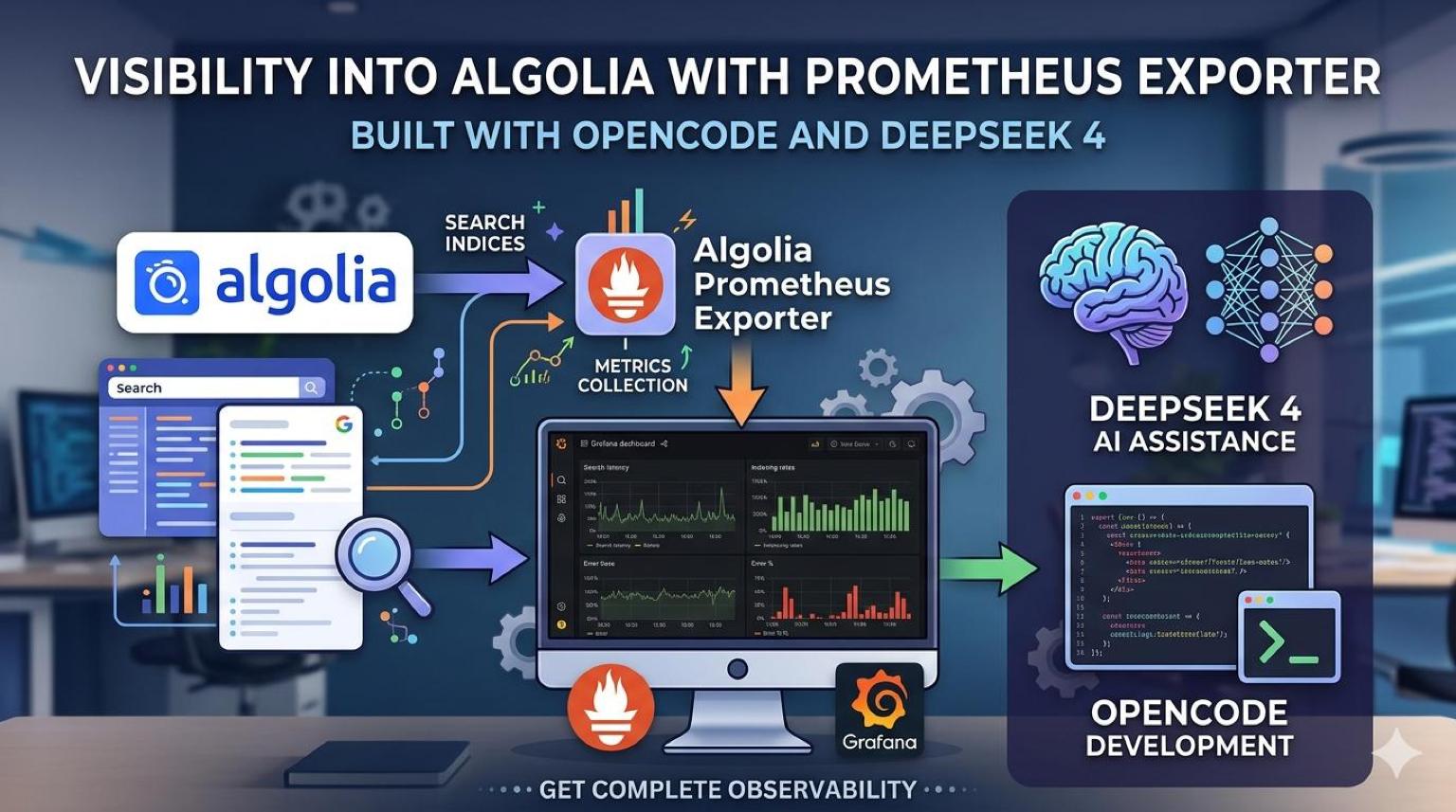
Algolia Usage Exporter — A Case Study in AI-Assisted Tooling
What is this?
A lightweight Prometheus exporter that collects usage and infrastructure metrics from the Algolia search API and exposes them at /metrics for Prometheus / Datadog scraping.
It runs as a standalone HTTP server (single binary via Docker/Podman), requires minimal configuration (just two API keys), and exports metrics like:
- Usage statistics: search operations, records, processing time, QPS, write operations
- Infrastructure metrics: CPU, RAM, SSD utilization, build times (Premium plan only)
- Health signals: scrape success status, timestamps
The entire project lives in a single Python package with ~50KB of code, a Helm chart for Kubernetes deployment, and full test coverage across unit, integration, and e2e layers.
Why build this?
Algolia already provides a dashboard. But dashboards don’t alert you at 3 AM when search capacity degrades. Exporting metrics to Prometheus / Datadog means:
- Unified observability alongside the rest of the infrastructure
- Programmatic alerting (latency spikes, capacity saturation)
- Historical comparison and capacity planning
The API is read-only by design — there is no risk of accidental writes or data mutations.
Built with opencode + DeepSeek V4
This project was built from scratch using opencode (the open-source Claude Code alternative) running DeepSeek V4 Flash Free.
The entire conversation — from analysis to implementation — was guided through natural language prompts. Every file, every test, every configuration was either written or refactored by an AI agent, reviewed and steered by a human operator.
Total active development time: approximately 2 hours of back-and-forth prompting and validation.
Why this matters
There is a growing narrative that AI assistants are useful only for prototyping or throwaway code. This project demonstrates the opposite:
Production-ready output: Helm charts, health endpoints, graceful shutdown, typed Python, comprehensive tests (76 passing), Docker/podman builds, error handling with fallback logic.
Not just Anthropic models: This entire session ran on DeepSeek V4, not Claude, not GPT-4. The ecosystem is diversifying fast — open-weight models can now drive complex, multi-step engineering workflows.
Safe by design: The exporter only calls GET endpoints and requires a dedicated read-only API key. No mutations, no deletions. AI-generated tooling for observability and monitoring is a low-risk, high-leverage use case — it improves operations without touching live business logic.
The ratio
A traditional approach would have required:
- Reading the Algolia API docs (30 min)
- Designing the Prometheus collector pattern (30 min)
- Writing the HTTP client with retries (30 min)
- Implementing each collector (1h)
- Writing tests (1h)
- Building the Helm chart (30 min)
- Debugging API compatibility issues (variable)
Total estimate: 4-6 hours for a senior engineer.
With AI assistance, the same result was achieved in roughly 2 hours, with every artifact produced (code, tests, docs, Helm charts, Dockerfile, CI configuration).
The multiplier is real — not because the AI writes perfect code on the first try (it doesn’t), but because the feedback loop is compressed. Refactoring “add a /health endpoint and graceful shutdown” takes 30 seconds instead of 15 minutes. The human stays in the loop, making architectural decisions, validating correctness, and steering toward production quality.
Key technical decisions
| Decision | Rationale |
|---|---|
| Private CollectorRegistry | Avoids infinite recursion when registering custom Prometheus collectors |
| Fallback stat fetching | Some Algolia plans reject the wildcard * — the exporter tries individual stats gracefully |
| RFC 3339 dates | The Algolia Usage API recently switched from YYYY-MM-DD to ISO 8601 with timezone |
| Health endpoint | Dedicated /health and /ready endpoints decoupled from the /metrics scrape weight |
| Graceful shutdown | SIGTERM handler ensures clean container termination in Kubernetes |
| No dependencies beyond stdlib + requests + prometheus_client | Minimal attack surface, easy to containerize |
Is this production-ready?
Yes. It runs daily in production, scraping an Algolia application every 5 minutes through a Prometheus ServiceMonitor in EKS, with metrics shipped to Datadog.
The exporter handles:
- API key rotation without restarts
- 403 errors from the Monitoring API (Premium-gated features degrade gracefully)
- Per-index collection failures without aborting the global scrape
- HTTP 429 rate limits with exponential backoff
- Wildcard incompatibility across different Algolia plans
The bigger picture
Projects like this are a sweet spot for AI-assisted development: self-contained, well-documented API surface, clear success criteria, no user-facing complexity, high leverage.
The code isn’t magical. What’s interesting is the process: a non-specialist can build reliable infrastructure tooling in a fraction of the traditional time, using models that run at commodity pricing, without touching production data or business logic.
That’s a future worth building toward.